Amateur Radio (G3TXQ) - Coaxial Antennas
From time to time I see suggestions that wire antennas can be constructed using coaxial cable for their elements as a way of reducing their size by exploiting the Velocity Factor of the cable. At first sight this is an attractive option: using typical 50 Ohm coax cable it might shrink an antenna to 66% its full size value. But I have often puzzled why, if it is that simple and effective, the technique is not more widely used. I decided to carry out some experiments, backed up by computer modelling, to explore the technique in more detail.
A. Does the use of coaxial elements reduce antenna size?
I constructed a simple horizontal dipole with each half comprising RG58 coaxial cable about 35 inches (900mm) long. I measured its lowest SWR, and the frequency at which the minimum SWR occured, for 5 different ways of connecting the inner and braid of the coax at the feedpoint. The 5 configurations were:
- Inners disconnected - fed between the braids
- Inners joined to one another - fed between the braids
- Braids disconnected - fed between the inners
- Braids joined to one another - fed between the inners
- Inners connected to their corresponding braids - fed between the braids
For each of these 5 configurations I made measurements with the tips of the elements firstly shorted, and then open circuit - making 10 combinations in total.
Configuration 4 failed to produce any noticeable resonant dip in SWR, with or without the tips short circuited. Of the remaining 8 combinations, all but one resonated in the range 72-76 MHz, typical for a “conventional” dipole of this size.
In passing, note that these findings confirm that replacing the Reflector element of a parasitic wire beam with a single piece of coaxial cable whose inner conductor and braid are shorted at the tips cannot exhibit any Velocity Factor shortening effect, even though I have seen this advocated in some designs published on the Web.
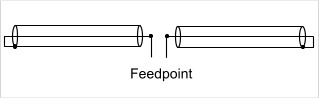
Just one combination exhibited a significantly lower resonance - at 47.5 MHz. It was configuration 3 with the tips short circuited, and is illustrated in the diagram to the right. Not only was the resonant frequency lower, it exhibited a surprisingly good match to 50 Ohm (VSWR = 1.1:1).
The drop in resonant frequency from 75.8 MHz to 47.5 MHz (63%) appears to indicate that the Velocity Factor of the coaxial cable does indeed shorten the dipole by an equivalent factor.
B. What is causing the reduction in size?
It is too simplistic to assume that using coaxial cable in place of a normal single wire element must produce a reduction in resonant length by virtue of its lower velocity factor. There is more going on here than at first meets the eye!
It is important to understand that the Velocity Factor of coaxial cable is a measure of the speed at which RF energy travels along the transmission line; and this in turn is dependent on RF energy being stored in the dielectric material which insulates the braid from the centre conductor. For energy to be stored in this dielectric, there must be a voltage differential across it, and this in turn means there must be opposing currents flowing in the braid and the centre conductor. If we examine all of the 10 combinations used in my experiment we will see that only in the configuration illustrated above is there a mechanism for producing these opposing currents; so it's not surprising that this is the only configuration that produces any significant shortening effect.
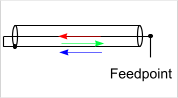
The diagram to the right illustrates, for one half of the dipole, the various current paths involved. The Red arrow shows the current flowing down the centre conductor of the coax from the feedpoint. There is an equal and opposing current shown by the Green arrow which is constrained to the inner surface of the braid. Finally, shown by the Blue arrow, there is a current flowing down the outside surface of the braid. If you doubt the ability of the braid to carry separate currents on its inner and outer surfaces, just think for a moment how a coaxial feedline often carries the differential-mode currents which drive an antenna whilst at the same time carrying (often troublesome) common-mode currents on its outer surface.
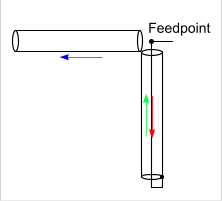 The next step in our understanding is to realise that only the Blue current can contribute to
radiation from the antenna; the Red and Green currents are in opposition and cannot contribute because
their fields cancel. It
is therefore legitimate to think of each half of the dipole as a radiating element carrying the
Blue current and a separate coaxial transmission line element carrying the Red and Green currents;
moreover, because the transmission line element does not radiate we can draw it as a separate
entity in any orientation we like, as shown on the right. In fact this is the recommended method
of modelling coaxial radiating elements. To quote from the EZNEC computer modelling "Help"
documentation:
The next step in our understanding is to realise that only the Blue current can contribute to
radiation from the antenna; the Red and Green currents are in opposition and cannot contribute because
their fields cancel. It
is therefore legitimate to think of each half of the dipole as a radiating element carrying the
Blue current and a separate coaxial transmission line element carrying the Red and Green currents;
moreover, because the transmission line element does not radiate we can draw it as a separate
entity in any orientation we like, as shown on the right. In fact this is the recommended method
of modelling coaxial radiating elements. To quote from the EZNEC computer modelling "Help"
documentation:
"A radiating coaxial cable can be modeled quite well with a combination of transmission line model and a wire. The transmission line model represents the inside of the coax, and the wire represents the outside of the shield. The wire is the diameter of the shield, and connected where the shield of the actual cable is."
Broken down into its component elements this dipole is now a lot easier to understand. The radiating element forms a conventional large diameter conductor, whilst the coaxial element forms a short-circuit stub in series with the feedpoint.
Now consider the behaviour of the antenna at a frequency where the length of the coax cable is just short of an electrical quarter wavelength. Because the radiating element is not subject to any Velocity Factor effect, it is well short of a quarter wavelength and so its complex feedpoint impedance will exhibit a large capacitive reactance. The short-circuit coaxial stub, being close to an electrical quarter wavelength, will represent a large inductive reactance in series with the feedpoint; this will cancel the capacitive reactance of the radiating element and bring the system to resonance. In fact the stub needs to be just short of an electrical quarter wavelength long; if it were exactly a quarter wavelength long it would theoretically represent an infinite reactance.
So we can see that the shortening effect is not caused by a radiating element that is somehow scaled in size by the Velocity Factor. Rather, it is an electrically-short radiating element that is brought to resonance by the inductive loading produced by a short-circuit coaxial stub. The distinguishing feature of the technique is that the inductive loading stub is conveniently made part of an "existing" antenna element.
To confirm this explanation, I took the two dipole legs and measured their impedances at 47.5 MHz when operating as short-circuit stubs; they were 16+j216 and 16+j215 respectively. Next I tried measuring the feedpoint impedance of the antenna at 47.5 MHz without the stubs in circuit. This proved very difficult - the high capacitive reactance of the antenna created severe common- mode problems which I reduced, but never completely cured. The EZNEC prediction for the feedpoint impedance is 22-j426, whereas the closest I measured was 23-j361.
Combining the measured stub impedances with the EZNEC prediction for the dipole feedpoint impedance,
we would expect the resultant coax antenna impedance at 45 MHz to be:
[16+j216] + [16+j215] + [22-426] = 54+j5
in other words, close to resonance with a VSWR of 1.1, just as we measured originally!
C. What's the catch?
i) Losses
The two short-circuit stubs, which provide the inductive loading to bring this electrically-short antenna to resonance, had impedances of 16+j216 and 16+j215; those represent "Q"s of about 13.5 compared to "Q"s of several hundred that we might expect for well-constructed conventional loading coils. They introduce an extra 32 ohms resistance in series with the feedpoint. The results is that the stubs absorb about 59% of the power applied to the dipole, and the radiated signal is reduced by nearly 4dB. We would have done better to replace the stubs with 0.72uH lumped inductors - with an inductor Q of around 200 the loss would be reduced to less than 0.4dB.
Incidentally, if the stubs had been much less lossy, the feedpoint resistance would have dropped and the VSWR would have risen - demonstrating once again that a low VSWR is no indication of antenna efficiency!
If our dipole had a radiation resistance significantly lower than 22 Ohms, the effect would be even more marked. For example, I modelled a shortened 9MHz Hexbeam driver constructed from RG58; it had an "unloaded" feedpoint impedance of 5-j560 Ohms. The loading stubs each exhibited an impedance of 45+j280 Ohms (Q=6.7), resulting in an aggregate feedpoint resistance of 95 Ohms, of which only 5 Ohms is contributing to radiation; the result is a massive 13dB reduction in transmitted signal.
ii) Bandwidth
I measured a 2:1 VSWR bandwidth of 7% when the antenna was operating as a "conventional" dipole, and just 2% when operating as a "coaxial dipole". The explanation is that the inductive reactance of a quarter-wave stub varies quite quickly with small changes of frequency; worse still, its reactance changes in a direction which exacerbates the situation: as the frequency drops, the capacitive reactance of the dipole increases, whereas the stub's inductive reactance decreases. The result is that there is only a narrow band of frequencies over which the stub can cancel the capacitive reactance of the radiating elements.
Again, lumped inductor loading would have been a better option. An inductor's reactance does not change so abruptly with changes of frequency and this option delivers an SWR bandwidth of 2.6% without the punitive losses of the stub; it also offers the flexibility to place the loading somewhere other than at the centre of the dipole with further improvements in bandwidth.
iii) Antenna size reduction
Although the use of coaxial elements can reduce the size of some antenna dimensions, other dimensions may remain unaffected. For example in a 2 element Yagi the Driver / Reflector spacing would stay substantially the same even if the elements were able to be shortened. It is naive to expect that the antenna will "shrink" uniformly in all dimensions. LB Cebik modelled a version of the VK2ABQ 2-element array built with RG58 cable and found that the perimeter of the antenna was only reduced to 80% of the full-size version - not the 67% which might have been anticipated - simply because the end spacing had to be increased in order to preserve the antenna's performance.
If this is not appreciated, performance is likely to be very disappointing. By way of example, I took the dimensions of a 20m Hexbeam and simply replaced the wire elements with RG58 coax. Encouragingly, the resonant frequency dropped to under 9MHz, but there were massive losses of 15dB and the F/B never bettered 3dB. The feedpoint impedance was above 100 Ohms - something that should really set alarm bells ringing on a small antenna.
D. Conclusions
We conclude that the use of coaxial cable can reduce an element's length by something approaching the Velocity Factor of the cable. However, the penalties are significant power losses and a much reduced performance bandwidth. Finally, in anything other than a simple dipole, the size reduction is likely to be significantly less than that predicted by a simple scaling based on the Velocity Factor.